by Anne Schaffer | May 13, 2026 | SAMS Missionaries
For believers in Jesus Christ, Easter is the ultimate celebration. We’ve made it through betrayal, death and now resurrection! Alleluia! Alleluia! The Lord is risen! If we’re not careful, though, we could see it as a culmination of the liturgical calendar and sit back until Advent rolls around to gear up for Christmas.
However, after the Resurrection, Jesus promised His Holy Spirit to empower His disciples to be His body and bring His kingdom to the earth. Specifically, He imparted boldness and power to bring His message of healing and salvation to all the families of every nation, starting at home in Jerusalem and extending to the ends of the earth. This promise, though, was coupled with a mandate, so the “go and make disciples of all nations” is not optional. Said positively, everyone gets to participate!
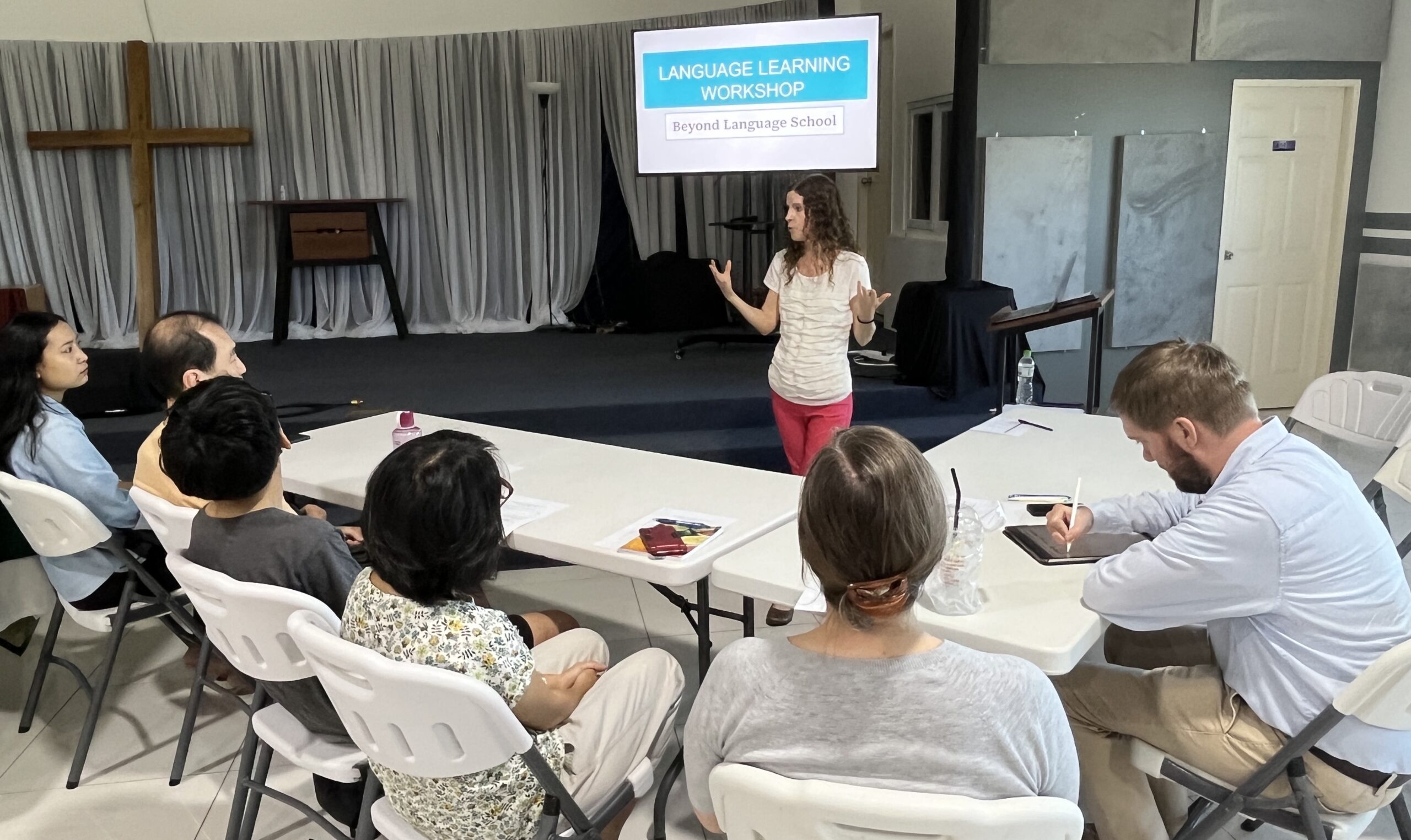
Anne leading a workshop in Cambodia last year
While all believers are on mission, the how and where look different. Some are called to leave homes, land, and families and go to distant places. This usually requires learning a new language and adapting to a new culture. If you’ve never tried it, this is not an easy task! It can be quite humiliating and overwhelming even for those who enjoy the challenge; and not all do. This definitely requires the Holy Spirit’s power! I would suggest that it is also a perfect opportunity for the Body of Christ to respond to Jesus’s command by offering support to the cross-cultural missionaries’ language and culture learning. How?
If you’re not familiar with it, I’d like to introduce you to the language and culture acquisition ministry, specifically coaching. While missionaries usually receive some type of pre-field training, there is often a lack of ongoing support once they’re on the field to help apply all the things they have learned to their specific situations. Even seasoned missionaries who go to a new setting will have different needs, which require new strategies and resources that they may not have needed or would not have worked in their previous environment. As a language and culture coach, I help learners–especially missionaries–identify language or cultural challenges, set goals, locate resources, overcome obstacles, and provide a source of accountability and encouragement through what is often a difficult and sometimes lonely journey. What’s great is that the language or culture learner actually gets to be part of the solution. We work together!
“While missionaries usually receive some type of pre-field training, there is often a lack of ongoing support once they’re on the field to help apply all the things they have learned to their specific situations.”
To give an idea of the impact that coaching can have, I will share just a few examples from the past few months:
- multiple missionaries identifying and receiving freedom from shame for not being further along in their language learning (which can be a major obstacle)
- a couple of missionaries shifting from avoiding speaking to actively pursuing opportunities to speak the language
- several missionaries changing the way that they communicate cross-culturally to relate to the local people in a more culturally appropriate way
A language and culture coach truly partners together with the missionary to equip and enable them to bring the Gospel to those who have never heard – or in some cases water seeds that have already been planted.
Recently, a new ministry called Connect Global was birthed to encourage and provide a means for the Church to join together to support missionaries in their language and cultural acquisition journey.
If you would like to know more about this ministry, I welcome you to contact me or visit my personal webpages in the bio below. I also ask you to please keep this ministry in prayer. As we celebrate Easter and consider Jesus’ mandate as Pentecost approaches, may we hear the call to join together as the Body of Christ on His mission to bring the Good News to the ends of the earth to make Jesus known. He is risen indeed! Alleluia! Alleluia!
This article has been adapted from its original publication on the New Wineskins blog.
 Anne Schaffer is a SAMS missionary, language and culture coach, and founder of Connect Global, a ministry serving to support cross-cultural workers in language learning and cultural adaptation. To learn more or connect with Anne, please visit Connect Global or SAMS, or email Anne Schaffer. She serves as a lay representative for the Anglican Diocese of South Carolina on the Anglican Missional Partnership Committee and as Vestry representative to the Mission Task Force at St. Michael’s Church in Charleston, South Carolina.
by Anne Schaffer | Sep 9, 2022 | Europe
If you’re expecting a rhythmic tune that will get the Sound of Music stuck in your head, sorry to disappoint. Just wanting to take the time to delight in the things that make me happy these days.
I really love getting to coach others who are trying to learn a new language and culture. I have added a learner, very informally, a friend who’s moved to France within the past year, via text! (Gotta keep up with the times, ha ha). It’s special to get to “coach” someone in a country and for a language that I do know and can actually relate firsthand to what it was like to go through the language/culture learning process!
On the other hand, it’s humbling and an honor to coach those who are serving in a place I’ve never been (Rwanda) and have only visited (Thailand). I’m so grateful to be gaining more resources that I can share with these learners and only wish I had more time to study and research!
On a selfish note, it’s also fun to learn things through them. This week, for example, I learned that Thai people almost never express their emotions, so much so that my friend who’s lived there for 7 years has never seen someone raise their voice or get angry–ever! I also learned that in Rwanda, people buy phone cards to…pay for their electricity. Oh man, I just can’t help but admire those who up and move to new places with new customs. To get to come alongside them is definitely a favorite thing!
Then–jump with me to the chocolate shop–imagine getting thanked and gushed at for simply handing someone a delicacy that you did nothing to make and can take no credit for whatsoever (though I did get to help make mendiants one day, but still won’t take credit as I just added the toppings to the melted chocolate, ha ha–but so fun!). This happens regularly and is a perk of working at a fine patisserie/chocolatier.
Another favorite is not something that I get to do on a regular basis, but has become a regular event every three years since 2016: New Wineskins! I hope to see you there, but heads up that if you can’t make it, they are offering live-stream!
I have a whole new appreciation for all that’s involved in this endeavor after being behind the scenes in the A/V booth the past several months. That, too, has brought joy when I hear of people–some very dear to me–who haven’t been able to physically attend a service or event but are able to still join and even somehow feel connected. Yes, I’ll add that to the list as one of my favorite things! What are some of your favorite things?
by Anne Schaffer | Aug 28, 2022 | Europe
Me: “Apparently, I don’t know how to tie a bow.”
Ashley: “Oh…” (The lack of words conveyed the mix of surprise and concern in her voice.)
This was a snippet of a phone conversation I had with my sister my first week of work at the chocolate shop. Let me add that I’ve been tying bows my whole life! Something else I didn’t know is that, according to Farlex Dictionary of Idioms, the English language has an idiom “to tie up in a bow.” (Am I the only one who doesn’t know this expression?)
It means “to take care of, finish, or resolve something fully and completely in a way that is satisfying or pleasing.” I suppose that is fitting as that is the end result of tying a beautiful, perfect bow…where the satiny side is up, textured side down, both bottom pieces are facing the same direction–again, keeping the satiny side up–is tight enough so that it will not move around, and everything is equally proportioned.
This is one of many examples of feeling incompetent in a new situation, as exciting and fun as the setting can be and as grateful as I am for the position. It’s timely, though, because this is exactly what happens to those who move to a new country with a different language and culture from their own. I can speak from firsthand experience that incompetence is part of the daily routine in a new cross-cultural setting! I suppose it’s apropos for me, then, to be in a situation where I can relate to those I’m coaching.
And yes, I’m coaching! The couple I mentioned in my last post did move to Africa–praise God!–and we have had two sessions already. I’m also coaching my friend who’s learning Thai and meeting with my mentor weekly and doing the coursework. The unit I’m currently working on is coaching adult learners, and this very issue–the need for adults to feel competent–is addressed!
I’m having to adjust a lot with so many new things and so much to learn, but I am incredibly grateful for each role I’ve stepped into in this season. We all know that feelings of incompetence are not just for cross-cultural learners, but can greet us even in our hometown (as I’m being reminded)! Not sure if you may be facing similar situations that tug at your emotional strength? If so, I’ll include you in my own personal pep talk: may the Lord be the security we need in humbling circumstances, whatever our location or life stage. May He tie all of our loose ends up in a bow so that when we’ve made it through the trials, we will be stronger and more like Him because of it. Ooh–feeling “pleased and satisfied” how that all came together…assuming I used it correctly, ha ha! 😉
by Anne Schaffer | Jul 6, 2022 | Europe
Last week was an exciting week as I launched into coaching! This calls for a huge thank you for those who have prayed for this as I’ve had several answered prayers that allowed for me to start sooner than I expected.
My first learner is a dear friend and coach herself, who is an intermediate Thai learner. Even though she could coach herself, she values the role of a coach and is game to take the role of a coachee. As thrilled as I am to coach her and am learning so much already, I needed a beginner level learner for the coursework. I’m thrilled to write that the Lord provided a couple going to Rwanda this August! We met last Wednesday, and they’d like to begin hopefully in August, depending on their leave date. In the meantime, my instructor/mentor gave me a case study to work on, and we met last Thursday to talk about it. It went really well!
I’ve been memorizing Psalm 20, and verse 4 states “May He grant you your heart’s desire and fulfill all your plans!” Just to be clear, I don’t believe this guarantees us getting whatever we want in life; but I did feel like each session I prepared for and each person I met with last week was playing out Psalm 20 in my life. Please pray that I will continue to seek the Lord first and have His desires and be mindful of His plans. I pray that for you too!
Okay, now I’m off to the chocolate shop for my first day on the job. Stay tuned… 🙂
by Anne Schaffer | Jun 15, 2022 | Europe
I said I’d need to explain the coaching, so here goes:
Often when I talk about language/culture coaching, I am met with blank stares or questions. A Language/Culture Coach can look differently in different contexts; but I’m interested in helping those–specifically missionaries–who are moving to a new country learn that language and culture so they can be successful and remain on the field.
Moving to a new country is a major event! If someone is moving to a location that speaks a different language, basic skills like speaking and listening are no longer possible! Let’s pause to let that sink in. Basically every area of life is going to be impacted and hindered–not just practically, but also socially and relationally.
The reason that missionaries even dare leave behind their family, friends, comforts, and all that is familiar is for the sake of relationship. Ultimately they want to introduce others to Jesus whose relationship allows people to then get to know God the Father…and let’s not leave out the Holy Spirit who helps reveal Jesus and births the life that is meant to be continually relating to Father, Son, and Holy Spirit. I started to apologize for the theological detour, but no way!  .
.
Imagine going through the blood, sweat, and tears (mostly figurative  ) it takes to learn a second language to be able to at least communicate even if there is embarrassment or struggle. If that were the only hurdle! Language, however, is intricately tied to culture. When we don’t understand the culture of a group of people, we can master the linguistics but fail to communicate–or worse, send messages of arrogance or disinterest. This, of course, closes people off rather than cultivating relationships. As a coach, one of my roles is to help the learner understand where culture plays into their experiences, relationships, communication, and language-learning so that they can be effective in their mission.
While Jesus supersedes us on so many levels, He Himself is our perfect example. He humbled Himself to become not just man, but first a baby, unable to talk. He developed His skills which thankfully do come much more naturally as an infant and child as He learned Aramaic; but He still went through the language acquisition process. He absorbed the culture of the Bible because this was where He lived and what He experienced on a daily basis. Olive branches, mustard seeds, farming, fishing, sheep–He grew up with these; so He could communicate with the people of Israel because He spoke the language and knew how to relate to them culturally. He could also beautifully relate to and bring the Gospel to those outside of his home culture despite the cultural and linguistic challenges, which is the precise role of a missionary.
Even if we were all language gurus and culturally savvy and sensitive to perfection, there is another element that language/culture coaching can address. Cross-cultural living presents situations and needs that don’t exist or at least look very different from those in our home country.
Living in a different culture can be exciting and rewarding, but by nature it is stressful and depleting. The constant change and different ways of thinking, understanding, and communicating put more demand on everyday tasks, making it difficult to identify the stress.
Though not an exhaustive list and maybe a bit repetitive, a coach helps the learner identify their language needs, sets realistic goals, and helps them to stick to or adjust the goals. (S)he can help them locate resources and discern which ones are suitable for the learner at a particular time. A coach can help the learner recognize obstacles or challenges and how to address them and encourage the learner each step of the way. A coach is a fan and source of support, praying for and with the learner. A coach may help the learner identify cross-cultural stress when it is not obvious. These are just a few examples because people’s situations are complex, and each unique person in a particular ministry context will offer its own set of possibilities.
For this reason, I believe that every missionary could benefit from a language/culture coach! My desire is to come alongside missionaries who are preparing to move to (and sometimes already in) a new country with a new language and new culture. I also believe that short-termers would benefit from a coach, but that’s another article for another time. 🙂