
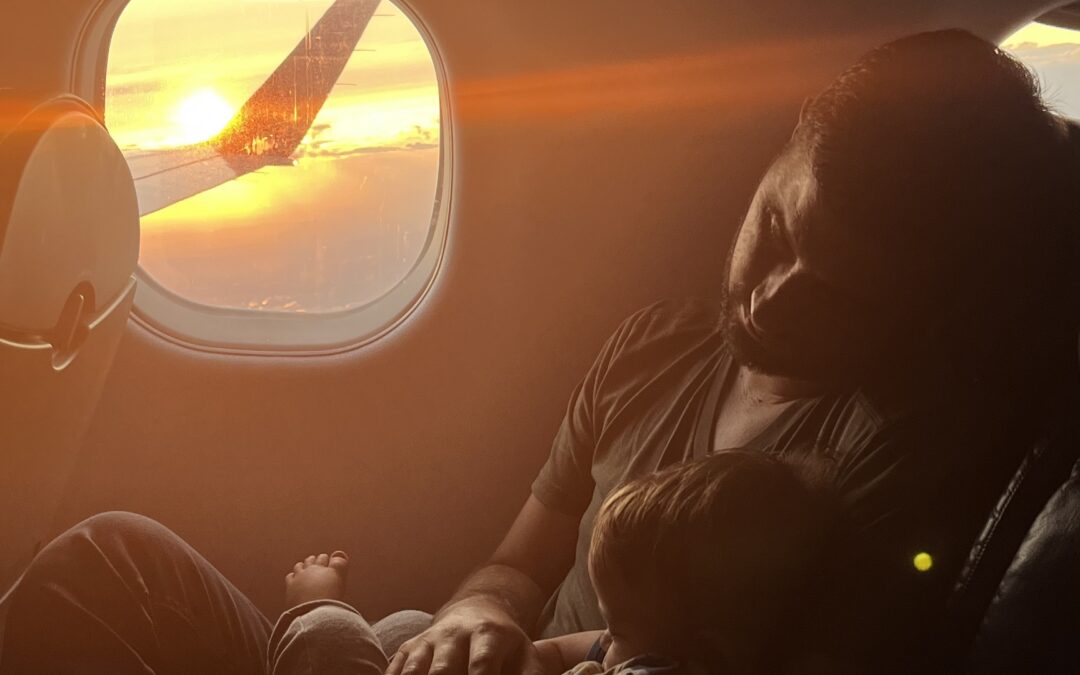
NYC to Pittsburgh – the last leg of our journey from Rwanda to the U.S.
Re-Entry: Transitioning with Grief and Joy
This is the fourth and final perspective in the series covering the various stages of missionary life. In this final stage we hear from SAMS Missionaries Chelsea and Wade Weeldreyer, who with their two children Evie and William, returned to the U.S. in 2025 after serving in Rwanda for several years. Both of them have transitioned to the U.S. to join the SAMS Home Staff in Ambridge, PA, to serve as Co-Directors of Missionary Care and Mission Engagement.
I was so emotionally worn out that my writings no longer had the energy for long sentences and I switched to poems.
— SAMS missionary Patsy McGregor, TAMANA: At Home in Africa
My experience returning to the U.S. after serving in mission in Rwanda paralleled Patsy’s at first: there was a lot swirling around in my mind and heart, and it was all pretty soup-like in terms of organization of thought.
My family had moved from indirect communication to direct; from house staff to American privacy; from a multilingual setting to monolingual; from living porously between indoors and outdoors to properly sealed, four-season homes; from censorship to freedom of speech; from a world where doing things last-minute signified cultural adaptation to a world where doing things last-minute just made you look silly. The list goes on.
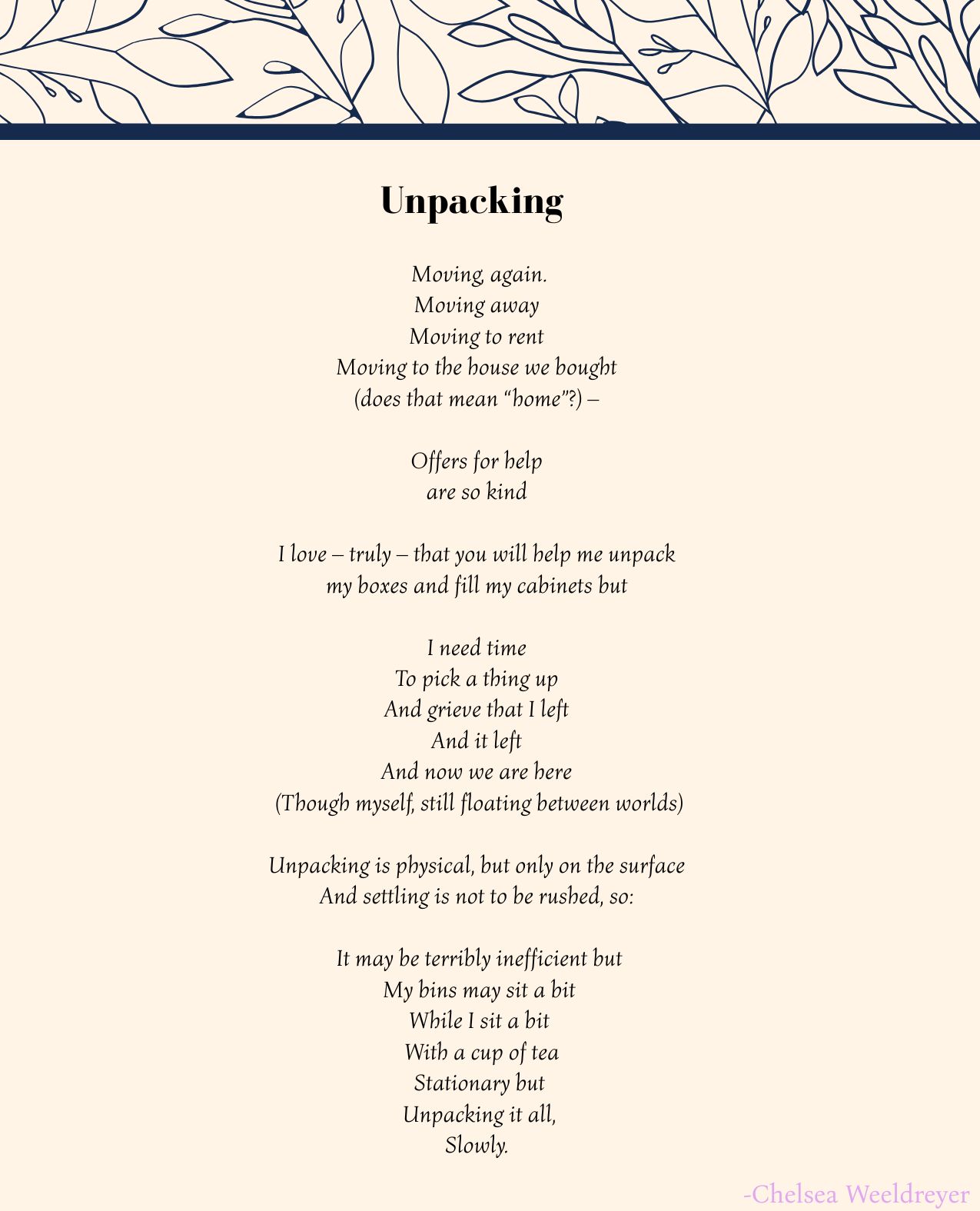
Like Patsy, I wrote poems. The two below are from my family’s early months back in the U.S. Even though my husband and I were transitioning to an exciting globally-focused ministry (and had the blessing of agency in the decision to leave our location of service), re-entry was draining and full of mixed feelings. Every missionary’s experience is unique – indeed, not everyone returns to their passport country after serving. However, some patterns seem universal, whether that’s needing time to grieve and not rush resettling (‘Unpacking’), or wrestling with raw emotions up front and later encountering God’s gifts of joy and security more deeply (‘TCK World Traveler’):

After several months back in the U.S., I sensed my thoughts slowing, settling, percolating. I became aware of the emergence of more mental and emotional space and capacity (amazing!). Here are just a few of my reflections from the first year of re-entering life in the U.S.:
Resettling was not linear
There were suggestions of linear progression: we bought a house, started new ministry roles, and the semblance of regular rhythms began to emerge. This was wonderful (indeed, something of an oasis experience) after so much uprooting and a packed summer connecting with supporters. I started to relax as I let go of the load of hypothetical futures that I’d long toted around.
At the same time, re-adjusting to the U.S. was not smooth and linear. A global move triggers a shift in all categories of life, from cultural norms to annual markers like holidays and birthdays. At any given time, some “buckets” felt full (e.g., a dependable schedule) while others felt empty (e.g., community) in relation to the life we’d left behind in East Africa. I loved my work, yet I missed living abroad. There was joy watching my daughter bravely enter kindergarten in a new place, but “Culture Night” at the elementary school put me to tears in an instant. And just when I started to think, I’ve got this, major holidays made me feel disjointed all over again, like another wave rolling in to knock me down. Our first Christmas back in the States was special, yet there was such a gulf between our “remember last year?” (or the last few years) memories and everyone else’s.
As a missionary going to serve, I recall feeling a sense of permission from others to have a topsy-turvy, non-linear experience. Many people have a category – perhaps even a dramatic imagination – for the unpredictability that comes with entering a different country and culture. But as a missionary returning from serving abroad, there was a sense that I should be able to fall back into step in the U.S. easily. That just wasn’t the case.

Emotional support dog in the airport: a sweet gift for a child making a global move!
I started thinking about linear progression from a cultural standpoint. U.S. culture loves a nice, straight, upward line of progress (we also like to believe we can achieve it!). In certain contexts, a linear model is a great framework. But that doesn’t mean it is always the best lens. A smooth, upward ride is also not the pattern we most see in the lives of God’s people in Scripture or throughout history. I have often found it helpful to think in terms of cycles as I’ve made transitions: move, enter, settle, “unsettle” to prepare for departure, move, enter, settle… By design, a cyclical journey leaves space for feelings and experiences to resurface and repeat in various ways. This model helps us see the bumps along the way as part of our progress, as God meets and anchors us again and again. It allows for more transparency with my children as we explore how different feelings can exist at the same time. It seems truer to life.
When my family reached our one-year anniversary of moving from Rwanda back to the U.S., I was pained by what felt like a final severance from our location of service. A linear model of progression may have said, Look how far you’ve come in twelve months! Where is your year’s worth of ‘upward and onward’ adjustment?! But the cyclical framework of thought said, Of course, you’ve arrived back to the same time of year, but everything’s different; there is joy, but grief makes sense too.
Building community was slow
Building community was slow, and not for lack of wonderful people around us. It’s simply the way relationships work. In the early months, it took a massive amount of emotional energy to (1) hunger for connection in our new location, but (2) simultaneously lack the capacity to pursue it. In part, this is because I was occupied by the lonely effort of redefining the friendships I’d left behind in East Africa. The identity of a missionary who’s just transitioned is still wrapped up in relationships with nationals and ex-pats from their location of service, but that’s largely unseen. This relational redefinition is more hidden, existing in the treasured but bittersweet space of calls and WhatsApp messages. (As it turns out, half of re-entry is indeed entering a new space, but the other half is leaving the old space – the land and the people and the ministry which all continue without you when you’re gone.)
Ironically, in the very midst of craving community, there can be a temptation to withdraw – especially if the missionary has already made several geographical shifts over the years and said lots of good-byes along the way. Painfully honest thoughts arise:
I can’t move on – I’m not finished grieving the loss of my old friendships.
No one can understand where I’ve come from.
If I become friends with him/her, what will happen if they move away?
No one knows me, or my memories.
Missionaries are not the only people who think these thoughts, but they can feel them in an accentuated way. I did. C.S. Lewis, in The Four Loves, gives voice to our fears around moving on: “To love at all is to be vulnerable. Love anything and your heart will be wrung and possibly broken.”
Ultimately, a question of trust emerges: Do I trust the Lord to sustain me in any season, in any place, in every way?
We know that it is worth it to say “yes”! Thankfully, God doesn’t ask us to handle self-preservation by ourselves (and missionaries are far from superhuman). Rather, He invites us to be living testimonies that His power is made perfect in our weakness. The call to life in Christ is always a call to community – life with and in the Body of Christ, life for the sake of the world that God has created. Because He promises to sustain (and his Body plays a role in this), we can open ourselves to rejoice and weep with others, to lean into new friendships, to step into new callings and new places. True, many people will not understand where the missionary is coming from (and it’s important to have designated individuals to process with along the way). That’s both an opportunity to grieve and, if others are keen to listen, an opportunity for the missionary to pour him or herself out in a new way, sharing about the Lord’s faithfulness in another corner of the globe and enhancing the local church’s ability to engage missionally.
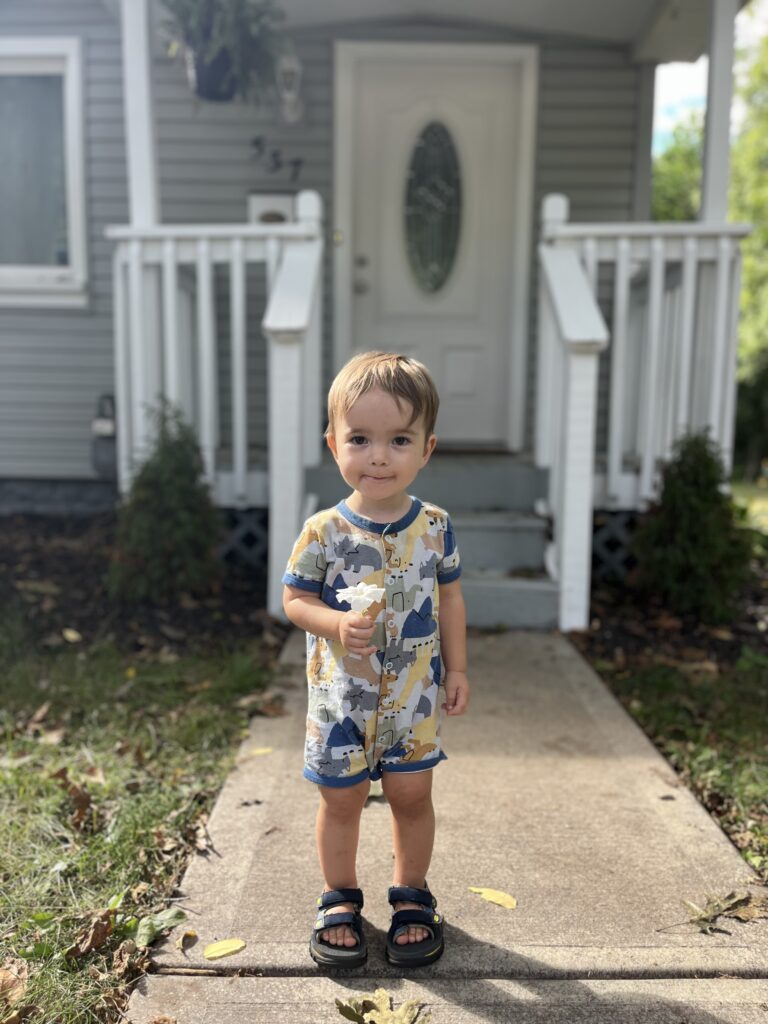
Outside our family’s new house (does that mean “home”?)
There is no way to wrap this up neatly with a bow: re-entry was a season where my husband and I rooted ourselves in conversations with each other, with God, and with key individuals in our lives as we dug our heels in and waited for the emergence of new relationships. We committed to a local church, showed up at the bus stop and met other parents, leaned into our new ministry roles, and waited, like seeds, for the slow growth of community.
God was constant
These days, I think often of the contemporary worship song Constant, which begins, “Just like the sunshine, you have been our light – leading us into beautiful places,” and later reads, “Just like the star light, you shine in the black night – leading us into beautiful places.”
Indeed, God has been my family’s light on both bright days and cloudy days, leading us into beautiful places (with a recognition that sometimes “beautiful” includes “hard,” too – is this not what the life of Christ shows us?). He has been our Constant in each season, showing us that all across His world, there is beauty in his creation, amazing individuals made in His image, and abounding opportunity to love him and love our neighbors. Though it’s so bittersweet, it’s a tremendous privilege to hold so much grief and joy in my heart at the same time for the sake of the Gospel.
 After serving a fruitful missionary term in Rwanda, Wade and Chelsea have launched into a new ministry by serving as Co-Directors of Missionary Care and Mission Engagement as part of the SAMS Home Staff Team. As Co-Directors they have been walking alongside potential missionaries, candidates, and current missionaries to join with God in global mission. They also serve as a resource for Anglican Churches as they raise up and send these missionaries throughout the world. They will focus on missionaries, supporting these families and individuals who share the Gospel of Jesus Christ in word and deed across cultures. They will also seek to encourage churches and all senders go deeper in their mission callings. You can read more about them here.