
by Lee Nelson | Nov 12, 2025 | SAMS Missionaries
 Last night, Ela and I plus three of our kids attended the Martinmas Festival in our little town in Germany. Schwarzenborn is the spitting image of a stereotypical German town – timber frame houses (we would call them Tudor), and a central parish church built in the 14th Century, all of which are bracketed by green hills with cattle farms. As I write this, there is a large herd of sheep on one of the hillsides. For Americans like us, words like charming, quaint, and lovely come to mind. But, Martinmas was an order of magnitude more lovely.
We were told to gather at the Seniorzentrum, our local retirement home. There, the elders of the community looked out their windows to see the children and parents, all decked out in warm clothes, the children carrying little LED lit lanterns that they had made earlier that day. A hymn was sung, and little mugs of Gluhwein (a hot spiced wine) were passed out – not to the kids of course. Then the procession began, led by a woman dressed as Saint Martin on horseback, complete with red cape. Boys and girls in the auxiliary of the volunteer fire department carried torches. People passed around bottles of beer as we walked up to the parish church. But we didn’t go in. Another song was sung, and then we continued on to the fire station for bratwurst, curry wurst, and pommes – they would never call them French fries here. The commemoration of Saint Martin of Tours is celebration of the very founding of Christianity in Western Europe. It can be said that no saint had a deeper impact on the flourishing of the Church in these parts than Martin. Saint Augustine of Canterbury’s parish church in Canterbury was dedicated to Saint Martin. Even the word chapel comes from the cape he tore in half, giving half to a poorly clothed and cold beggar by the side of the road, Jesus himself. It is said that pieces of this cape were sent out as relics through this early somewhat Roman, somewhat Gothic set of kingdoms, and as buildings were built around these pieces of Saint Martin’s capel, they became known by that word, in French chapelle and in German kapelle.
 Martin represents a crucial turning point in European history, perhaps more than even Constantine, in which the warrior class of centurions and barbarians is rejected for a new reality: Christians marked by charity. As historian Tom Holland has pointed out, the history of Europe is the story of barbarians tamed by the Gospel. But, it wasn’t just barbarians. The whole order of Roman power and military might was brought to its knees. Today, we live in that part of Europe which was once the Holy Roman Empire, a land which some might call post-Christian. I happen to think that this term is woefully inadequate, for Europe cannot cease to be Christian in certain overt ways – this little celebration of Martinmas being one of them. The better term is one used by the Dutch missiologist Stefan Paas, who calls it post-secular. Secularism blew through Europe in the 1960’s, affecting not only society, but the Church as well. It became understood that the Church must keep up with the times, must change, must be open to her own secular future. Theologians spoke of the “death of God” and many people began to live in an entirely secular frame. Yet the last seventy years have shown us that this secular “triumph” was pronounced too soon. A revival of Christian faith and practice is sweeping through Europe. Historians are pointing out that Europe’s most deeply-held values: care for the poor, universal medical care, human rights, and equality before the law to name a few, are all Christian in origin. An exclusively secular view has no room for such deeply-held values.
 I would say that cracks in this secular mindset were most visible in Nazi Germany. This brutal regime held to the ideals, not of Christianity, but of social Darwinism, believing that man set free from the chains of the Christian past could fulfill his destiny of becoming a whole new race. For the Nazis, the Christian witness of Saint Martin’s care for the poor was best characterized as weak. Post-war Germany, divided between western capitalist industrialism in the west and Soviet ideology in the east – both, incidentally, forms of secular liberalism, served to isolate people from Christian believing, and quite successfully. Today, less than 3% of the German population is in church on Sundays. Yet, practices remain. Sunday is a day of sabbath rest. It is called Ruhetag – the quiet day. I was in Berlin on a Sunday recently and the quiet on the streets of a city of 4.3 million was terrifying. All grocery stores are closed. Holidays like Martinmas are celebrated with vigor.
As I looked around last night, the turnout would have made any church leader brim with excitement. Strollers and little kids everywhere. Mothers and fathers together, laboring for the good of their community. Everyone being so wonderfully kind. This is post-secular Europe. It is Christian in ways, but these ways do not include such essentials as prayer, sacraments, or creeds. This is both the opportunity and the challenge. What I have learned in nearly four months living here is that.
 Lee and Ela Nelson and their children reside in Schwarzenborn, Germany where Lee is leading the Knüll Camp and Conference Center. As the new director, Lee is developing a training center to encourage the planting of healthy, multiplying churches throughout Europe. Lee and Ela envision it as a strategic place to launch initiatives like the training center as well as to make the camp a hospitable refuge for beleaguered Christians, lay and clergy alike. Visit their Missionary page here.

by Lee Nelson | Nov 12, 2025 | SAMS Missionaries
by Logan Gates, SAMS Missionary Candidate to Chile
Have you ever been asked a question about faith and not known what to say? This happened to me a few years ago on the campus of Arizona State University. I was handing out flyers for an event on faith and reason, when a professor came up to me and asked, “Are you one of those Christians who believes in sin?” I was caught off guard and couldn’t think of anything to say besides, “Yes.” Right away he shot back, “Why do you have to go around making people feel bad about themselves? Why do you have to come and do that here?” I had responded with an answer that was biblically faithful, but I could tell that he didn’t leave the interaction with an accurate impression of the Christian faith, because he didn’t see Christianity as having any “good news” to offer!
As Christians we hear and see many types of objections to our faith. “Science and religion cannot be reconciled.” “The Bible is just a collection of myths.” “Christianity is misogynistic and homophobic.” “There can be no good God in a world with so much suffering.” When non-Christians raise such topics, sometimes we can feel tempted to tell people they just need to believe. Why should Christians care about such questions and objections?
In 1 Corinthians 9:22, the Apostle Paul writes, “I have become all things to all people, that by all means I might save some.” When we hear this verse as Christians, we might think of Hudson Taylor, the nineteenth century missionary to China, who took the unprecedented step of adopting Chinese dress to better connect with the local people. But what about becoming all things to all people at the level of their questions about faith? That is the domain of apologetics.
The term “apologetics” can generate mixed reactions among Christians. To some, it can imply that we are “apologizing” for what we believe. For others, apologetics is associated with getting into arguments with people, or trusting in reason instead of the Spirit to change people’s hearts. Some Christians go so far as to say that apologetics is something we should toss out altogether.
But the word apologetics is actually one that is found in the Bible. Perhaps the most prominent place it shows up is in 1 Peter 3:15, where Peter writes, “But in your hearts honor Christ the Lord as holy, always being prepared to give an answer to anyone who asks for a reason for the hope that is in you; yet do it with gentleness and respect.” The word translated as “answer” is the Greek word apologia, which is a legal term meaning a “reasoned defense.” In other words, “apologetics” doesn’t have to do at all with apologizing but rather offering a reason for the hope that we have in Christ.
How do we do that exactly? To start, Peter tells us our apologetic should be given with “gentleness and respect.” The hope that is within us looks and sounds much more winsome to a hearer when we give a gentle and respectful answer that is also reasoned. On top of this, it’s interesting that Peter doesn’t tell Christians to give an answer to a person’s questions, but rather the person behind the questions. Peter tells us we are to give an answer to any “one” who asks about the hope that we have. This distinction may seem like hair splitting, but often as Christians we can find ourselves giving correct answers, like I did to the professor at Arizona State, while failing to reach the person and the deeper concern behind the question itself.
To give another example, if someone asks us why a good God would allow evil and suffering, we might be tempted to jump to a philosophical answer. But it is very possible that the person who has asked this question is undergoing intense suffering themself, and the philosophical answer won’t hit home. Perhaps what they need most is for us just to listen, to express sorrow, or to pray for them. We need to resist the temptation to jump in with an answer.
How do we grow in answering people and not questions? We can follow the example of Jesus, who often answered people’s questions by asking questions in return. One case where Jesus does this is when he is asked by the rich young ruler in Luke 18, “Good Teacher what must I do to inherit eternal life?” Of all people, Jesus knew the answer to this question! Nevertheless, Jesus responds to this question with a question: “Why do you call me good? No one is good but God alone…” By responding in this way, Jesus drew out from the rich young ruler the deeper barrier keeping him from entrusting his life to Jesus: he thought he was good enough for God.
Of course, we aren’t Jesus and don’t have his supernatural insight into what’s going on in people’s hearts. But there are good questions we can ask to better understand the questioner behind the question. We might ask something like, “May I ask why you asked that question?” or “Is this something you’ve felt for a long time?” When people make blanket statements about the Christian faith (i.e. “science has proved that God doesn’t exist), we can ask clarifying questions: What do you mean by “science”? What do you mean by “prove”? How did you come to that conclusion? Often this will lead to the person opening up more about what their real issues are when it comes to God, which gives us the chance to engage them at the level of the heart and help them see the reason and beauty that is to be found in Christ and His Gospel.
Now, there will be times when we need to not just ask questions but also give “answers”! It might be that someone we’re speaking with really does want to know about how science can be reconciled with faith, or what evidence there is that the Bible is historically reliable. In those cases, we might have some homework to do! After all, Peter says we are to be “prepared” to give an answer – and getting prepared takes time and effort. It can be overwhelming to think of preparing for all the possible questions our unbelieving friends and family members might have. But a good place to start is thinking through for ourselves why we believe that Christianity is really true. What “reason” do we find most compelling for believing in the God of the Bible? It could be that the Lord has intervened in our lives in a dramatic way, or that we see his glory in creation, or perhaps we find compelling evidence that comes from science, history, or philosophy. Your answer to this question will help others who are seeking.
You might next think about who are the non-believers whom God has placed in your life, and whether you’ve asked them what are the barriers that hold them back from believing in Jesus. You might not know how to answer in the moment, but you can always thank them for sharing and say you’ll think about it further. This gives you the chance to look into their questions and find resources and answers that could be helpful for them. Your friend will appreciate that you took the time to care about their questions!
A final thought. It’s striking that in 1 Peter 3:15, before Peter has anything to say about how we are to answer, he talks to us about the importance of our own hearts before God: “But in your hearts, honor Christ the Lord as holy…” What matters far more than our particular answers is the integrity of our own walk with the Lord. To paraphrase the British evangelist Michael Ramsden: it might be we have all the answers ready, but no one is asking us any questions. In that case, we need to ask how we are living, and whether that leads people to ask about our hope – and want it for themselves. Lord, help us!
 Logan Gates is an Adjunct Speaker with Apologetics Canada who, along with his wife Samantha and their son Lewis, is preparing to serve in Chile as a Missionary Candidate with SAMS. Visit their Missionary page here.
by Lee Nelson | Feb 26, 2025 | SAMS Missionaries
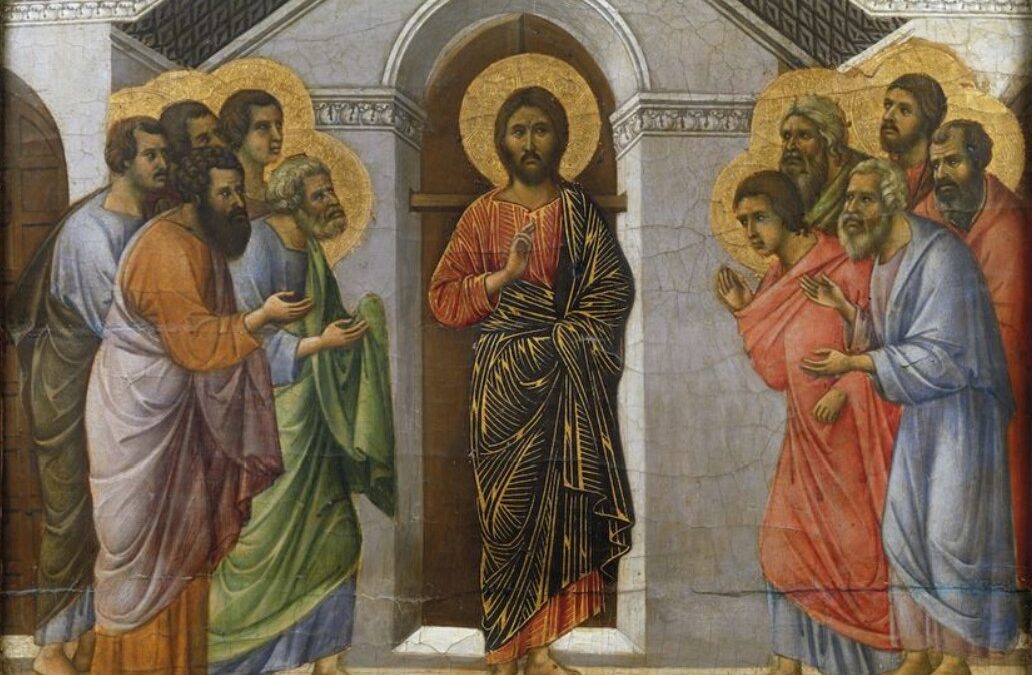
Jesus said to them again, “Peace be with you. As the Father has sent me, even so I am sending you.” (John 20:21)
The idea of mission is not an exclusively Christian term. Corporations have mission statements. Astronauts are given missions. In one of my favorite movies, two bluesmen set out on a “mission from God” to save their childhood orphanage. The word is a Latin one, missio, and simply means “to send.” So, when Latin translators of the New Testament set out to translate passages like the one above, the choice required very little thought: missio.
It is from this simple, probably mindless choice in translation that we get the whole concept of mission. It is simply to say that we Christians understand ourselves to be a sent people, a people on the move. The Apostles understood that if they were anything, they were men who had been sent out – to Judea, Samaria, and to the ends of the earth. (Acts 1:8) If you track the story of the Acts of the Apostles, this is exactly what happens. On the day of Pentecost, the apostles are driven by the Holy Spirit out of the room where they were staying and the Gospel is proclaimed to Jews from all over the world. At the end of Acts, Paul and his party have come to Rome in chains. How did these early missionaries think about themselves? The answer, I think, comes in the Gospel of John. On the very day Jesus is raised from the dead, he appears among the disciples and offers a very Jewish greeting: “Peace be with you.” This is not all he says. The Lord could have simply said “I am sending you,” but in addition to giving them a mission, he makes it clear how and by what power they are sent.
“As the Father has sent me.”
Another way to put this phrase could be something like “In the same way as the Father has sent me.” And how has the Lord Jesus been sent by the Father? Several things can be said about this, but let’s start with the immediate. The immediate sending, which the disciples would have been perplexed by, was this astonishing presence of their Lord among them when three days before, he had been brutally disfigured, crucified, and laid in a tomb. Friends, this is the power, the nuclear engine, behind the Church’s mission in the world, the same power which raised Jesus from the dead. The mission of the Church is fueled by the astonishing and miraculous work of the Holy Spirit. The disciples are sent, to put it simply, as a Resurrected Body into the world. This is the nature of the Church, being the body of all those who have been baptized, buried with Christ, and raised with him to eternal life. (Romans 6)
Consider another angle. Jesus is sent not only by the power of the Holy Spirit, but as God and Man in one divine person. He is not sent as an idea, or an invisible spirit, or just a human being. The eternal Word of the Father is sent in the flesh. And the apostles are sent in the same way. I heard recently of a Christian who was setting out to plant a church entirely online. While I’m sure his intentions are good, this is not mission according to the mission of Jesus. The Apostles understood that they could not just send a letter and be done with it. They had to go in person.
But, there is so much more, consider what Jesus was sent to do! To heal the sick, to drive out demons, and proclaim the Kingdom of God! In this time, people were very aware that Caesar Augustus had proclaimed his own rule with supposed miracles. Therefore they understood that for Jesus to go around proclaiming a kingdom and healing the sick was nothing less than a challenge to the status quo of the empire. While making no violent or existential threat to the empire, it is a serious challenge nonetheless, serious enough that he was crucified for the crime of insurrection. In every age, missionaries have been sent, not to overthrow governments, but to proclaim the kingdom of God while simultaneously feeing the hungry and healing the sick, often in miraculous ways.
The bigger idea that I want you to get is this: that Jesus is sending out his Church on mission as the continuation of His incarnate body on Earth. This is why Paul writes “You are the body of Christ.” (1 Corinthians 12:27) The Church is that body which proclaims the Gospel of the Kingdom and participates sacramentally in the Lord’s incarnate body. The ancient Church understood, as we do today, that the fuel for mission is the very indwelling of human life by the Holy Spirit, nourished by participation in the Eucharist, and all of this “for the life of the world.” For this reason, we can say with confidence that every Christian, no matter where they are or what they do for a living, is a missionary. The existence of so-called missionaries only reenforces the point: the particular subsists in the whole.
As the Church is sent out into the world, her aim is no different from that of her Lord: to love and save lost humanity. I can think of no better mission statement.
by Lee Nelson | Feb 24, 2025 | Europe, Germany
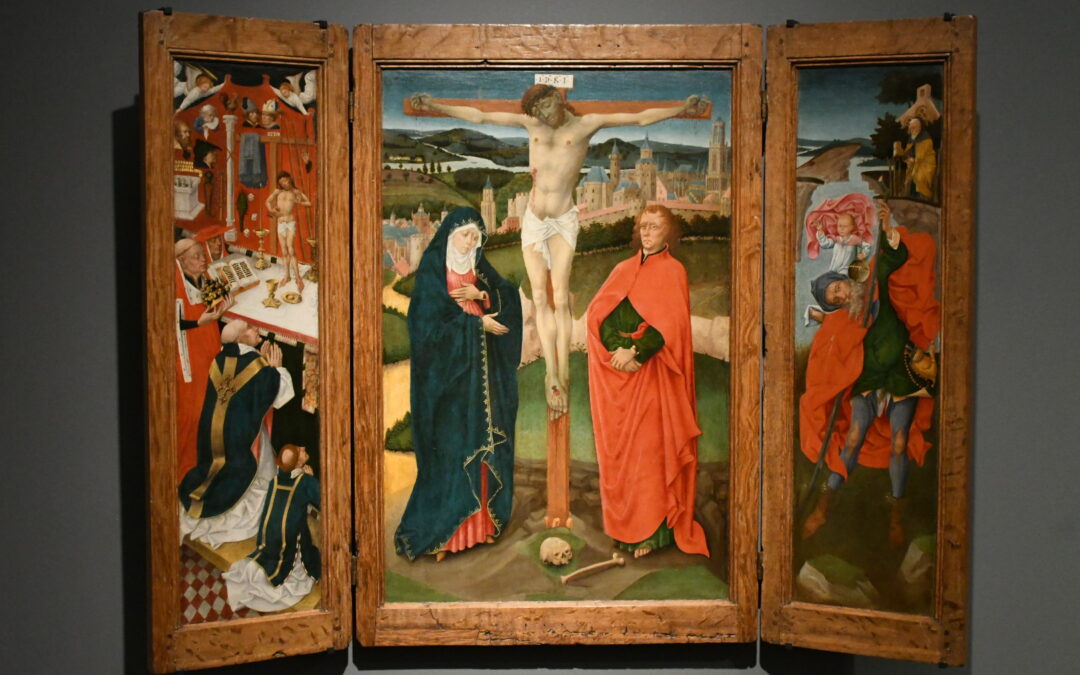
 Two weekends ago, I took my older kids on a trip to Germany and The Netherlands to prepare for our deputation to Germany as SAMS Missionaries. After taking them to see our future home, I decided to take them up to Amsterdam, specifically to see the wonderful Van Gogh Museum. But, before this, we took the time to see the Reijksmuseum, their national museum, filled with the treasures of dutch art and culture. Think Rembrandt and life-size paintings of the Battle of Waterloo. One of the things I dearly love about this particular museum is how the museum is laid out chronologically. I’m not sure if this was intentional or not, but the first exhibit on this chronological exploration of Dutch art is their medieval collection, consisting entirely of Christian art.
It is, to say the least, a stunning collection of processional crosses, bishop’s croziers, altarpieces, statues, and iconography. So stunning that my oldest could not help but weep. But it was in that exhibit that I overheard a conversation between two middle-aged women.
“It’s just all so sad.”
“I know, all the death, and superstition, and war.”
But they weren’t weeping. That was my daughter, overwhelmed by the beauty and majesty of what can be rightly described as Europe’s glaringly obvious Christian history. Of course, it isn’t all glorious. But, that for several hundred years, the only art that anyone made was explicitly Christian, whether a statue, or a painting, or a cathedral, or a tune is not sad. It’s a testimony to the Gospel. You see, the history of Europe is the history of a barbaric people being tamed by the Gospel. Warring, murderous, unruly masses coming to be truly civilized, not through technology or scientific knowledge, but by coming to know the goodness and mercy of God. It wasn’t all perfect, but today in most of the countries of Europe, only 3% of each population claims any kind of living relationship with Jesus Christ. In Germany, there are more Muslims in mosques on Fridays than Christians in Church on Sundays. The most popular baby name in Germany last year was Mohammed.
Europe truly wrestles with this identity crisis. Some call for tighter controls on immigration. Others call for tighter controls on guns and knives. But, at the core of the problem is this: secular Europe is unrooted and being unrooted, it will fall to cultures only slightly more rooted than itself. Many today erroneously believe that it was Europe’s Christian past that drove the tragedies of two world wars and a Cold War, with millions brutally murdered. Yet, these great injustices were not caused by Christianity but the rejection of it. In reality, secular Europe is like a zombie – walking around in the clothing and world of Christianity, but without a beating heart or a well-tuned mind.
The people who once built cathedrals and illuminated manuscripts are truly in a state of death. And unlike the 15th Century, very little stands in the way of Islam’s hostile takeover of the entire continent.
But, there are great reasons to hope. Firstly, many secular Europeans are now spontaneously claiming that they are nothing less than Christian. They understand that to cling to all that is good about European society and culture is to be, at the heart, a believing Christian. They cannot escape the evidence. It is all around them. Believe it or not, this is the “hot topic” at universities like Oxford and Cambridge: “Can one truly claim the European intellectual tradition as his own if he is not a Christian?” Secular university students are coming to faith in droves, turning to radical lives of evangelism and mission. Many who once saw Christianity as just the sad past of their culture, now see it as the essence of all they hold dear.
Last August, my wife and I experienced, as we had been experiencing for many years in more subtle ways, a call to mission in the heart of Europe. In the coming months, we will be relocating with our seven children to a former Nazi-era German army base that has, for the last fifty years, been a camp and retreat center for the Reformed Episcopal Church in Europe. We believe that the Lord has granted us a vision of seeing the radical multiplication of churches on the European continent through deep catechesis and equipping for ministry. We’re deeply humbled to do this as missionaries with SAMS as it means we are not only joining a society of other faithful missionaries, but a society of generous and prayerful senders.