
In recent years there has been a conspicuous trend in North American theological education: small, residential seminaries with strong denominational identities are those most likely to be in institutional decline, while large, interdenominational seminaries that permit online coursework are fully ascendent.
Furthermore, now that higher education is staring down the rise of an Artificial Intelligence so formidable that it can find, analyze, and synthesize biblical and theological information at the push of a few buttons, the decision to seek a seminary degree and to endure the sacrifice required to pursue it can seem outdated, even illogical. Why not simply serve in one’s local church and turn to a nearby mentor – or the Internet – for guidance and training?
This new environment is forcing seminaries in North America onto their back foot, as it were, to justify their mission to students and donors. And for missionaries abroad laboring to make the case for offering robust, in-person theological education for church leaders from all around the world, promoting a traditional seminary model can be challenging. Why form these leaders in ways that demand so much time, money, and human resources?
The people I speak with regarding my family’s upcoming ministry, teaching students from around the world through Tyndale Theological Seminary in the Netherlands, routinely question the need for pastors to attend seminary – and even the idea of seminary itself. However, when I was discerning a call to ministry several decades ago, I never questioned the basic premise that I would need to relocate my life to a brick-and-mortar theological college to prepare for a lifetime in ministry. Nevertheless, today that basic premise has largely gone out the window. I regularly meet pastors who have not studied at a seminary, and many of those who have undertaken theological studies have done so part time, and often online.
Let me suggest that a look at some context – where seminaries came from, and what they offer students in residence – may help explain why they remain crucial for training leaders for the global church. Seminaries were designed as “seedbeds” for new ministers, and emerging leaders lose out when they have no affordable access to such formation.
Seminary in Years Past: the “Seedbed” for New Ministers
In his 2015 The History of Theological Education, Justo González observes that in early Christianity, theological education was not reserved for specialists alone. Rather, the church as a whole saw its own vocation as theological and educational: when people came to faith in Christ, they were taught to study the Scriptures, to speak of God and for God, to grow into maturity as part of a community of disciples of Jesus. For centuries, training in Scripture, theology, and church history was an activity of the whole church for the whole church.
As the Western Roman Empire crumbled, monastic movements rose up that preserved Christian education amid societal chaos. However, while these communities transmitted vital knowledge, medieval universities had little to do with the training of the average clergyman. In contrast, the Protestant Reformation in the sixteenth century sought to equip preachers as experts in Scripture. Combining the medieval humanities curriculum – the liberal arts and sciences – with a Protestant theological curriculum, universities began producing graduates who were not only well-rounded scholars, but who also aimed at being faithful pastors. At the same time, Roman Catholic seminaria – literally, “seedbeds” – were being developed that offered what Protestant colleges in Europe and evangelical seminaries in North America were providing as well: a community of teachers and learners who would study Scripture, doctrine, languages, and history, all the while living and worshiping together to prepare for ministry in the church.
So, Why Make Attending a Seminary a Priority Today?
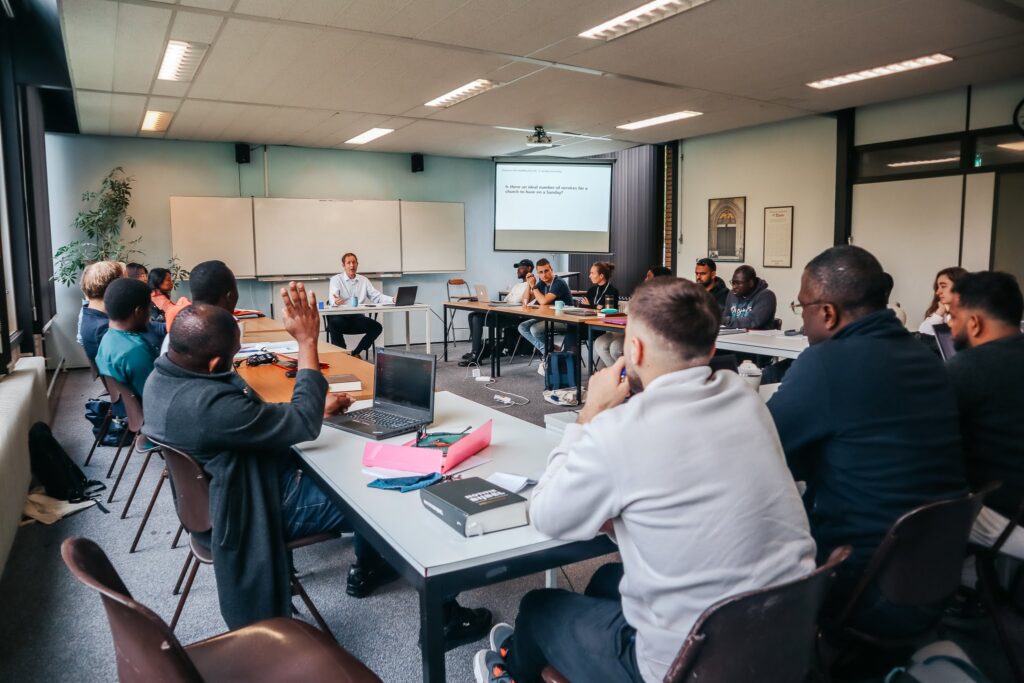
Seminary students in the classroom at Tyndale Theological Seminary, Badhoevedorp, Netherlands
This ideal of the “seedbed” remains my preferred way to prepare leaders for the church around the world. Like González, I hesitate to draw a line between catechesis and college, between Sunday School and seminary: the whole church is called to explore the things of God and make him better known! But we live in a time when the average Christian has not been formed well at home or in the pew, and certainly not well enough to take the reins of a church and lead Christ’s flock as a shepherd in His name.
Most who are called to vocational ministry need extra study, extra exposure to the Word of God, extra time spent in worship with others who are preparing. This means having access not only to professors to guide these studies, and not only to libraries whose contents can challenge and awaken new ideas, but also to a freedom from other obligations and responsibilities. Perhaps not everyone is called to spend significant time and money to access this kind of maximized education, but some are – and above all, those who will lead.
Along those same lines, few of us have experience living together with other Christians in this kind of intentional community. Seminaries were composed as a kind of monastic fellowship, devoted to a common mission and to one’s fellow missioners. The “life together” that happens in such fellowship while preparing to serve Christ’s church is difficult, painful, bewildering, and yet profoundly sanctifying. While a local church can and should offer the same opportunity to go deeply into this kind of intentional Christian fellowship, many do not. For most of us, our first experience of forming part of a daily fellowship of worshipers, students, and servants of Jesus Christ comes when we arrive at seminary.
Yes, the conventional seminary model is expensive to run, and the strain of study can deprive students of the leisure and space required to absorb the ideas and skills being fostered. But the models of professional formation that are increasingly replacing the old residential seminary model of academic rigor and community life cannot measure up to the older ideals of relational mentorship and skillful mastery. In some cases, new models for pastoral training are needed for economic reasons. And in others, churches may not wish to send away their best young people to receive an education far from home with little chance of their returning. Better to train them in-house for free, they might conclude, or to send them online for asynchronous coursework or AI-assisted queries, than to pay for three years of study living at a college far from the parish.
However, I am convinced that the Lord honors what we give away with no expectation of a return on the congregation’s investment. Planting a young person in a “seedbed” far away is to store up treasures in heaven rather than build the kingdom on earth, to cast one’s bread upon the water in hope that it will somehow return. I myself have witnessed the Lord bless the (Baptist) church that first encouraged me to go to seminary, and I have seen the Lord prosper those in the (Anglican) church who helped sustain me while I was studying at a (Presbyterian)
seminary. Which is to say, to commission a seminarian to study is a group effort, not unlike sending a missionary to unknown lands. In both cases, we should be confident that obedience to Christ’s command and trust in his promises will yield a plentiful harvest of righteousness that will redound to those who scattered those seeds.
Seminary Life and the Call to Global Mission Today
I am now looking forward to teaching as a missionary at Tyndale Theological Seminary, a college that is equipping new missionaries to serve Christ around the world by giving them full access to an affordable postgraduate education. Most of my missionary work until this point in South and Central America has been in areas that lacked affordable access to this “seedbed” model of ministry formation. God was visibly at work, but the barriers to leadership were visible too. It was especially hard for cash-strapped congregations to send ministry candidates to a seminary far from home. For Anglicans, this difficulty meant that fewer people were sent to train for ministry, and so smaller and more rural churches (like ours in Belize) rarely enjoyed having resident clergy. For others, this meant that many pastors never received the fuller formation
that seminaries provide. Beyond certain unintended errors in doctrine, we found that these under-equipped leaders were at greater risk of emotional burnout and vocational shipwreck. As missionaries, we came away convinced that while a seminary education is not the only path to effective ministry, it is still ordinarily the best way to equip Christians to serve as leaders in Christ’s church.
All this feeds my excitement to serve at Tyndale Seminary! I look forward to teaching students from Ghana and Cameroon, Ethiopia and Pakistan, Guyana and Hong Kong, and from so many other places, who, despite differences in nationality and denomination, desire to seek God’s face together. Each one who comes has seen the value of theological education in community, and each is making sacrifices to show up in person, becoming present not only to the professors in class, but to one another as well. Each has left family and loved ones, career and income, heart language, comfort food and cultural music, all to prioritize these crucial years in the “seedbed” before being transplanted back as missionaries into their native soils. My prayer is that this dedicated time and space with one another will have formed healthy roots that will serve them well throughout the years of ministry to come.
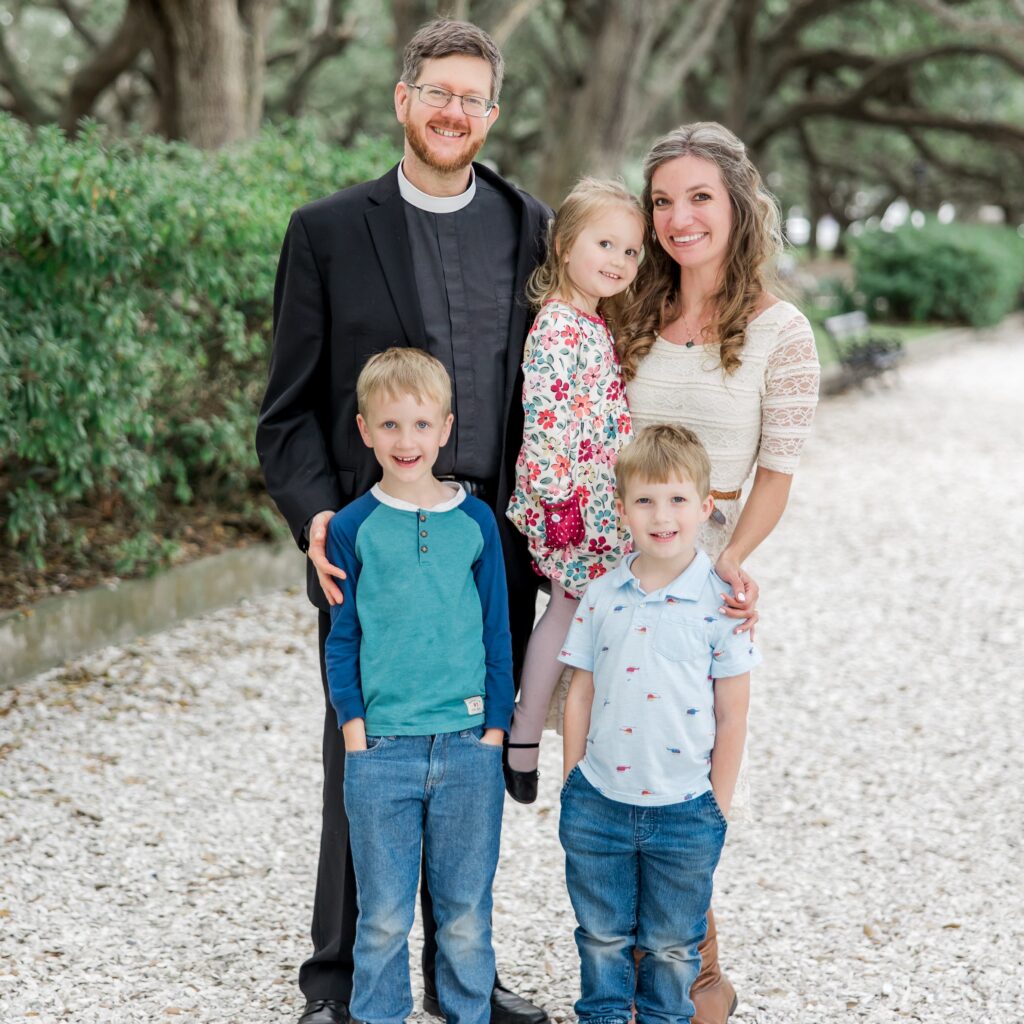
David and Mary Beth Alenskis previously
served as SAMS Missionaries providing
pastoral leadership in churches and
schools throughout Latin America and
the Caribbean, and they are currently
preparing to serve at Tyndale Theological
Seminary in the Netherlands. At Tyndale, David will have the opportunity to offer Christian theological
instruction to seminary students from all over the world, thereby contributing
to building up well-trained leaders for service within the global Church.
David recently completed his PhD at Wycliffe College and the University
of Toronto, and David and Mary Beth, along with their three children, are
currently U.S.-based as they seek Senders to walk alongside them in order
to fulfill their calling to the Netherlands and the nations.
Thank you, David.